A regular update on the cross-border legal, regulatory, and commercial developments that matter to life sciences and healthcare companies, investors, and their advisers — across mainland China, Hong Kong SAR China, the US, and the EU.
In this issue
1.For most importers, the US pharmaceutical tariff does not take effect until 29 September 20262.The UFLPA Entity List now names nine pharmaceutical and biotechnology companies
3.China has opened priority review to chemical APIs
4.New rules for pharmaceutical representatives took effect on 1 August 2026, binding both reps and healthcare institutions
5.Reimbursement screening for indication-restricted drugs now covers every therapeutic class, with the check moved to the point of prescribing
6.China's Good Clinical Practice has been comprehensively revised and takes effect on 1 September 2026
7.Regulators have drawn a clear line between cell therapy and gene therapy products, and the Order 818 filing track has opened — so far almost entirely to regularise studies that already existed
8.Guangzhou and Beijing are both widening free-trade-zone access for foreign investment in human stem cell and gene diagnosis and therapy work
9.Outside China, drugmakers are being named in congressional inquiries, the FDA has no confirmed commissioner, and three EU flagship bills remain unadopted
Headlines
1. For most importers, the US pharmaceutical tariff does not take effect until 29 September, 2026
Status: In force, phased — United States — Proclamation 11020 of 2 April 2026; Annex III companies from 31 July 2026; all other importers from 29 September 2026
Signed on 2 April 2026, Proclamation 11020 imposes a 100 percent ad valorem duty on imported patented pharmaceuticals and their associated ingredients. The tariff takes effect in two stages: for the 17 companies listed in Annex III, the 100 percent duty applies from 31 July 2026. For all other companies, a zero percent interim rate applies until 29 September 2026, with the full rate taking effect on that date.
Reduced rates are available. Products of Japan, the EU, South Korea, Switzerland and Liechtenstein are subject to 15 percent. Companies with an onshoring plan approved by the Secretary of Commerce pay 20 percent, rising to 100 percent on 2 April 2030. Companies that have both an onshoring agreement and a most-favoured-nation pricing arrangement with HHS pay zero until 20 January 2029. The UK rate was cut to zero, retroactive to 31 July 2026. Clause (3)(d) sets a zero rate for drugs where all approved indications are all orphan designations, andor nuclear medicines, plasma-derived therapies, fertility treatments, cell and gene therapies, and chemical, biological, radiological and nuclear countermeasures. Generic pharmaceuticalsand their ingredients, and US-origin products, are not subject to the tariff at this time.Why it matters: Most companies still have several weeks to decide who acts as importer of record, whether to seek an onshoring agreement, and how to position inventory. The analysis depends on the product: cell and gene therapies and orphan-only products are zero-rated, while conventional patented small molecules are subject to the full 100 percent tariff. The tariff is triggered by patent and ingredient status, not country of origin alone. And because relief is negotiated company by company, the same product can attract different duty rates depending on which entity serves as the importer of record. Companies should therefore evaluate whether restructuring the importing entity could reduce their tariff exposure.
Source: Proclamation 11020 (2026-04-09); BIS notice (2026-08-04); CBP CSMS guidance; as of 2026-08-19.
2. The UFLPA Entity List now names nine pharmaceutical and biotechnology companies
Status: In force— United States — Federal Register notice published and effective 3 August 2026
On 31 July 2026, DHS added 43 entities to the UFLPA Entity List, bringing the total to 187. The expansion was publicly framed around five high-priority sectors, none of them life sciences. Yet the notice also identifies nine pharmaceutical and biotechnology companies. The nine were added not because of the sector they are in, but because of their supply chain origin. Three of the nine are located outside Xinjiang, i.e., in Jiangsu and Guangxi. Two manufacture antibiotic intermediates and cephalosporins that Western supply chains are most likely to encounter unknowingly.
Why it matter: Companies should assess UFLPA exposure by reference to the specific entities and supply-chain relationships identified under the UFLPA Entity List, rather than relying on broad sector or geographic assumptions. For pharmaceutical supply chains, this may require tracing relevant inputs beyond the finished-product supplier, including APIs and key starting materials.
Source: Federal Register notice (2026-08-03); DHS announcement (2026-07-31); as of 2026-08-19.
3. The Chinese mainland has opened priority review to chemical APIs
Status: In force— The Chinese mainland — NMPA Announcement No. 25 of 2026 — Announcement on Matters Concerning the Application of the Priority Review and Approval Procedure to Chemical Active Pharmaceutical Ingredients (NMPA, issued 1 July 2026, effective 1 August 2026)
The NMPA has extended the priority review and approval procedure to chemical active pharmaceutical ingredients for the first time, addressing the long-standing bottleneck in which a finished formulation entered the fast lane while its linked API remained in ordinary linked review.
Four categories qualify:
(1) An API linked to a formulation already in priority review may be included alongside it.
(2) Where an API used in an approved domestic formulation has only overseas manufacturing sources, the first domestic applicant may qualify.
(3) Where an API currently supplying an approved originator product in China is to be imported or transferred to domestic manufacture, it may qualify.
(4) APIs identified by the State Council as being in market shortage are admitted directly.
Why it matters: Category (3) is a clear regulatory incentive: it encourages moving originator API manufacturing into China. Therefore, where an API is made now matters for tariff treatment in the US and review timeline in China.
Source: NMPA Notice No. 25 of 2026 (nmpa.gov.cn); as of 2026-08-19.
4. New rules for pharmaceutical representatives took effect on 1 August 2026, binding both reps and healthcare institutions
Status: In force — The Chinese mainland — Measures for the Administration of Pharmaceutical Representatives (Announcement No. 42 of 2026, seven agencies: NMPA, MPS, NHC, SAMR, NHSA, NACTM, NCDPA, effective 1 August 2026)
The Measures for the Administration of Pharmaceutical Representatives took effect on 1 August 2026, replacing the 2020 trial filing rules. They apply to marketing authorisation holders, the professional organisations they engage, pharmaceutical representatives, and healthcare institutions and their staff. The Measures prohibit holders and representatives from assigning or undertaking sales targets, collecting payments or handling invoices. Representatives may not tally prescriptions or give inducements to healthcare staff or their relatives. Holders must complete filing changes within 30 days. Where a holder engages a contract sales organisation, it remains responsible for the organisation's compliance and must issue separate authorisation letters to each representative.
Why it matters:The Measures impose obligations on both pharmaceutical companies and healthcare institutions, not just on representatives. The enforcement provisions go beyond fines: violations can lead to publication of the breach, priority supervision status, and restrictions on participating in drug procurement or signing medical-insurance designation agreements. This is the first time promotion-related misconduct can directly affect a company's ability to commercialise its products. Outsourcing sales activities to a contract organisation no longer shields the holder from liability.
Source: Announcement No. 42 of 2026 (seven agencies); as of 2026-08-19.
5. Reimbursement screening for indication-restricted drugs now covers every therapeutic class, with the check moved to the point of prescribing
Status: In force — The Chinese mainland — NHSA intelligent-supervision indication-restricted drug rules and corresponding knowledge-point schedules, batches 15 to 20 (NHSA, published 16 June to 22 July 2026)
Between 16 June and 22 July 2026, the National Healthcare Security Administration published six further batches of its “indication-restricted drug” rules for its intelligent supervision system. The rules cover:
(1) dermatologicals, genito-urinary agents and sex hormones, and systemic hormonal preparations;
(2) systemic anti-infectives;
(3) antineoplastic and immunomodulating agents, and musculo-skeletal agents;
(4) nervous-system agents;
(5) respiratory and sensory-organ agents and others;
(6) proprietary Chinese medicines.
Batch 15 covered dermatologicals, genito-urinary agents and sex hormones, and systemic hormonal preparations; batch 16 systemic anti-infectives; batch 17 antineoplastic and immunomodulating agents and musculo-skeletal agents; batch 18 nervous-system agents; batch 19 respiratory and sensory-organ agents and others; and batch 20 proprietary Chinese medicines.
With the sixth batch, all major therapeutic categories are now covered. Provincial healthcare authorities must update their systems accordingly, and medical institutions are encouraged to integrate the rules into their prescribing systems to flag non-compliant prescriptions before they are issued.
Why it matters: These rules affect what the insurer will pay for, not how products are promoted. The key change is that claims for uses outside a product's reimbursement limitation are now flagged at the point of prescribing, rather than caught later in an audit. If a product's reimbursement limitation is narrower than its approved label or actual usage, that gap is no longer a grey area, and it becomes a measurable denial rate. Market-access and medical teams should reconcile each product's reimbursement limitation against its label and prescribing patterns, and expect provincial systems to apply the same rules.
Source: NHSA rules, batches 15–20 (nhsa.gov.cn, 2026-06-16 to 2026-07-22); as of 2026-08-19.
6. China's Good Clinical Practice has been comprehensively revised and takes effect on 1 September 2026
Status: Issued, not yet in effect — China — Announcement No. 50 of 2026 — Good Clinical Practice for Drug Clinical Trials (four agencies: NMPA, NHC, NACTM, NCDPA, dated 21 May 2026, published 8 June 2026, effective 1 September 2026)
China's Good Clinical Practice (GCP) has been comprehensively revised and takes effect on 1 September 2026, replacing the 2020 version. The new rules were issued by four agencies (the NMPA, the National Health Commission, the National Administration of Traditional Chinese Medicine, and the National Disease Control and Prevention Administration), up from two in 2020. Key changes include a new standalone chapter on data governance, clearer allocation of responsibilities (the principal investigator is ultimately responsible at the trial site, while the sponsor is ultimately responsible for trial-related activities), and alignment with the principles of ICH E6(R3). The term “subject” has been replaced with “trial participant.”
Why it matters: From 1 September, all trials running in China must comply with the new GCP. Companies should complete a gap analysis of their standard operating procedures, CRO agreements and data systems before that date, with particular focus on the new data governance requirements and the shift to risk-based quality management. The revised GCP also affects whether clinical data generated in China can be accepted by overseas regulators.
Source: Announcement No. 50 of 2026 (nmpa.gov.cn), dated 2026-05-21, published 2026-06-08; as of 2026-08-19.
7. Regulators have drawn a clear line between cell therapy and gene therapy products, and the Order 818 filing track has opened — so far almost entirely to existing studies
Status: In force - The Chinese mainland — CDE Notice No. 39 of 2026 — Technical Guiding Principles on the Scope and Classification of Cell Therapy Products (2026 Edition); and CDE Notice No. 40 of 2026 — Technical Guiding Principles on the Scope and Classification of Gene Therapy Products (2026 Edition) (CDE, dated 1 July 2026, effective on issue); Order 818 filing lists, batches 1–6, June to August 2026
The Center for Drug Evaluation issued two classification guidelines in July 2026, one for cell therapy products and one for gene therapy products. The key distinction: ex vivo genetically modified cells, including CAR-T, are classified as cell therapy products because the final active substance is a cell. In vivo CAR-T products, which deliver nucleic acids via a vector to modify cells inside the body, are classified as gene therapy products.
Separately, the clinical research filing system under State Council Order 818 is now operational, and its first three months show what it has actually been used for. Six batches of filings have been published, covering 93 studies between May and July 2026. Each batch annexe carries a footnote recording whether a project had previously been filed under a predecessor regime, and 90 of the 93 had been — under either the 2015 trial measures for stem-cell clinical research or the trial working guidance for somatic-cell clinical research — and are being re-filed to meet the one-month transition deadline in Article 57 of the Regulation. Only three of the 93 carry no predecessor filing. Filing is done through a single national window at the National Health Commission, with no fee and no provincial step. In July, additional technical guidance was issued on the evidence required to convert a filed study into an approved clinical technology. As of this brief, no clinical translation application has yet been approved.
Why it matters: Classification determines a product's review path and manufacturing standards. For products on the ex vivo/in vivo boundary, companies should make the classification call at project inception, not just before filing. The clinical translation pathway is only open where no drug with the same mechanism has been approved or entered confirmatory trials in China. An approved technology is limited to the participating institutions for one to five years, depending on risk, and can be removed from the guidance list once an equivalent product is approved. The filing data adds one more point: in its first three months the channel has been used almost entirely to regularise studies that predate it, and with no translational approval yet issued, the path is open on paper but essentially untested by new entrants, so the timelines it implies should be treated as unproven rather than observed.
Source: CDE Notices Nos. 39 and 40 of 2026; Order 818 filing lists and their project-information annexes, batches 1–6 (cncbd.org.cn), including the batch footnotes recording prior filings under the 2015 stem-cell measures and the somatic-cell working guidance; Guo Wei Ke Jiao Fa [2026] Nos. 12 and 13; as of 2026-08-19.
8. Guangzhou and Beijing are both widening free-trade-zone access for foreign investment in human stem cell and gene diagnosis and therapy work
Status: One issued, one in consultation — China — Guangzhou measures issued 2 July 2026; Beijing draft published 12 August 2026, consultation closed 18 August 2026
The national negative list still restricts foreign investment in human stem cell and gene therapy. But two cities have moved to expand pilot access within their free-trade zones.
Guangzhou's measures, issued on 2 July 2026, support qualified foreign-invested enterprises in the Nansha free-trade area to engage in the development and application of human stem cell and gene diagnosis and treatment technologies for product registration and manufacturing. The city also intends to extend the pilot to the Sino-Singapore Knowledge City and plans to introduce local legislation on cell and gene therapy.
Beijing published a draft on 12 August 2026 for public consultation, which encourages foreign-invested enterprises in the Beijing Pilot Free-Trade Zone to engage in the same fields and offers competitive funding of up to RMB 5 million per project in designated areas. The Beijing measures remain a draft.
Why it matters: The national restriction has not changed, but Guangzhou and Beijing are creating carve-outs at the zone level. Guangzhou's plan to introduce local legislation on cell and gene therapy suggests these pilot policies are intended to be durable, not temporary. For foreign investors that had treated this field as closed, the question is no longer whether access exists, but where and on what terms. This is now as much about site selection as it is about regulatory compliance.
Source: Guangzhou measures (2026-07-02); Beijing draft (beijing.gov.cn, 2026-08-12, comments closed 2026-08-18); as of 2026-08-19.
9. Outside China, drugmakers are being named in congressional inquiries, the FDA has no confirmed commissioner, and three EU flagship bills remain unadopted
Status: Congressional letters (US, non-binding); a personnel vacancy (US); three EU instruments short of adoption
On 29 and 30 June 2026, the chair of the House Select Committee on the Chinese Communist Party wrote to five large pharmaceutical companies. The letters requested information on their due diligence and standards for trials conducted at Chinese military hospitals and in Xinjiang, including IP and data protection. Responses were requested by 17 July. The letters are not legally binding. But they mark a shift: this is the first time China clinical-data pressure has been directed at named Western sponsors rather than at the FDA. The concerns have expanded from data reliability to IP flows to the military and the validity of informed consent.
Separately, the FDA has had no Senate-confirmed Commissioner since 12 May 2026. The deputy commissioner for food has been acting since mid-May. On 18 and 19 August, media reported that the White House had decided to nominate a White House domestic policy deputy director to the post. As of this brief, she had not been confirmed by the Senate.
In the EU, three instruments are advancing but none is law yet:
(1) The pharmaceutical package reached provisional agreement in December 2025 and committee endorsement in March 2026. It is close to adoption, with an indicative plenary vote in November 2026. It offers eight years of data protection plus one year of market protection, with possible 12-month extensions up to a total of 11 years, plus a transferable 12-month data exclusivity voucher for priority antimicrobial developers.
(2) The Critical Medicines Act reached provisional agreement on 12 May 2026. The final text is expected in the Official Journal towards the end of 2026.
(3) The European Biotech Act was proposed on 16 December 2025, with supporting analysis published in May 2026. Trilogue negotiations are expected in Q4 2026.
Until each is adopted and published, the law in force remains Directive 2001/83/EC and Regulation 726/2004.
Why it matters: Where a trial was conducted is now a question companies may have to answer publicly and in writing, regardless of whether any regulator has objected to the data. Site history is now a diligence item with a political dimension. On the EU side, the protection architecture affects valuation and generic-entry planning. The key point is not that exclusivity periods are longer or shorter, but that they are now conditional on conduct and subject to a hard cap. However, none of this applies until adoption, so planning should continue under the current directives and regulation.
Source: House Select Committee letters (press reporting, 2026-06-29/30); FDA nomination press reporting (2026-08-18/19); European Parliament Legislative Train; Council of the EU press releases (2025-12-11; 2026-05-12); European Biotech Act; as of 2026-08-19.
Also watching
The Chinese mainland.The 12th national volume-based procurement round opened on 31 July, with 65 drugs procured and 521 products from 327 companies winning proposed selection. The rule changes — two bidding rounds, revived reference drugs without volume commitments, and stricter qualification for overseas generics — matter more than the product list. The three-month remedial window for expired conditional approvals closed in late July. Provincial white lists for personal medical insurance accounts at retail pharmacies are due by end-September. NMPA moved device classification toward rolling adjustment (Announcements Nos. 52 and 53 of 2026). State Council Order 843 (effective 15 August) made 12 amendments and three repeals, with only a narrow EIA wording change to the pathogen laboratory biosafety regulation. Two five-year plans landed: the National Health Plan names cell and gene therapy, novel antibodies, vaccines, nucleic acid drugs and radiopharmaceuticals; the Universal Medical Security Plan proposes a first-launch price mechanism based on company self-assessment, writes the commercial-insurance catalogue into the framework, and commits to five years of full inspection coverage.
Hong Kong SAR, China.Two requirements took effect. Medical gases became regulated as pharmaceutical products under the Pharmacy and Poisons Ordinance (Cap. 138) on 14 June 2026 and must be registered. From 31 March 2026, initial registration applications for products containing a new chemical or biological entity must comply with ICH Q1A–E stability guidelines.
What has not moved. As of mid-August, the following had not moved. State Council Order 837 (outbound investment security review) has been in force since 1 July but remains unimplemented. There are no implementing measures, no catalogue, and no filing form. BIOSECURE is law but not operative. The company list has not been published (due December 2026) and the FAR has not been amended. H.R. 9102 (licensing into outbound review) remains introduced, with no markup. China's export control catalogue is unchanged. May 2026 reports of expansion to antibody, small-molecule, nucleic acid and CGT technologies remain unconfirmed. The HGR implementing rules revision remains a draft; the 2024 Regulations and 2023 rules still govern. The DIP version 3.0 grouping scheme, originally planned for July, has not issued. The national restricted clinical technology catalogue has not been updated. The biotechnology R&D safety regulation, in draft since 2019, is not in the State Council's 2026 legislative work plan. The Medical Security Law passed second reading in April and remains under deliberation. The 2026 reimbursement and commercial-insurance catalogue adjustments will not be final until October or November.
Source: NHSA and the National Joint Procurement Office (nhsa.gov.cn, 2026-06-23, 2026-07-30, 2026-07-31); NMPA Announcement No. 41 of 2026; Notice of the NHSA General Office and the Ministry of Finance General Office on Strengthening Supervision of the Use of Employee Basic Medical Insurance Personal Accounts at Designated Retail Pharmacies, Yi Bao Ban Fa [2026] No. 7; NMPA Announcements Nos. 52 and 53 of 2026; State Council Order No. 843; National Health Plan for the 15th Five-Year Period, Guo Fa [2026] No. 23; Universal Medical Security Plan for the 15th Five-Year Period, Yi Bao Fa [2026] No. 17; Hong Kong Department of Health and Pharmacy and Poisons Board; State Council Order No. 837 and the three-department press Q&A (2026-06-01); MOFCOM and MOST Announcement No. 28 of 2025; US Treasury Outbound Investment Security Program; State Council 2026 legislative work plan, Guo Ban Fa [2026] No. 14; as of 2026-08-19.
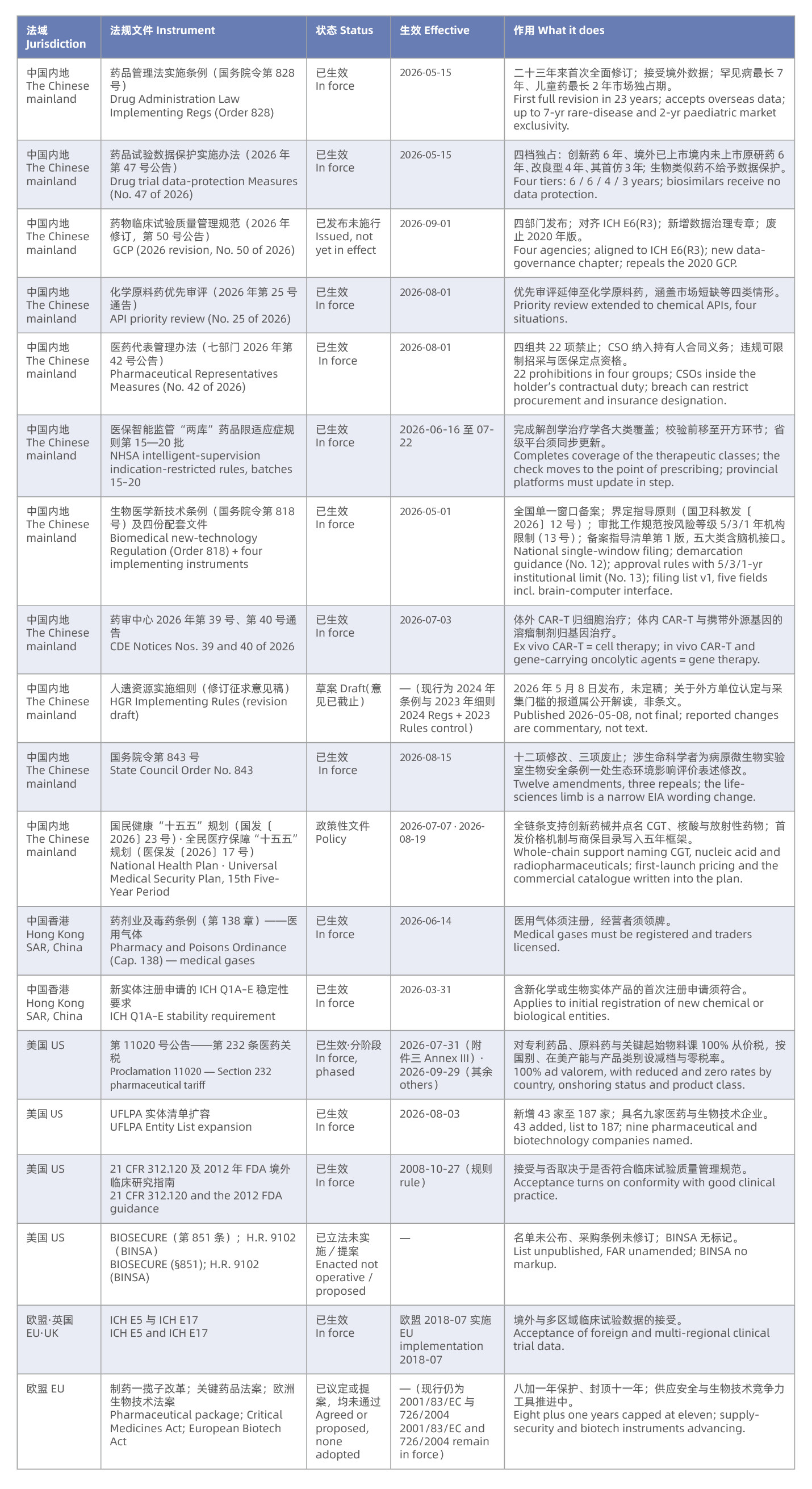
Regulatory tracker
Feature
What actually took effect is not what the market was watchingOver the past two briefing cycles, we have tracked outbound investment review, procurement restrictions, export controls, and a bill that would bring licensing itself into review. As of mid-August, none had moved.
What did take effect sat on a different track. The US imposed tariffs on imported patented drugs and APIs, and added nine pharmaceutical companies to the UFLPA Entity List based on where their inputs come from. China, four weeks before the US tariff takes full effect, opened priority review to chemical APIs — an incentive to move API manufacturing into China. The EU is legislating on supply security.
The same pattern holds in China. The market has been watching reimbursement catalogue adjustments, the payment grouping scheme, and a cell therapy consultation — none have produced results. But on 1 August, the pharmaceutical representative rules took effect, with consequences beyond fines. Separately, the reimbursement authority extended indication-restricted screening across all therapeutic classes, moving the check to the point of prescribing.
The market should focus more on rules already in force than on policies still under discussion. Key dates ahead include: 1 September (revised GCP), end-September (retail pharmacy white lists), 29 September (US tariff), October–November (reimbursement catalogues), and December (BIOSECURE list).
Source(s): See items 1 to 9 and the Also watching section above; as of 2026-08-19.
What this means for you- If you import patented drugs, APIs or key starting materials into the US and are not in Annex III, decide by 29 September on importer of record, onshoring agreement, and zero-rate eligibility.
- Screen supply chains against the UFLPA Entity List itself, down to API and key starting material level. Do not rely on sector framing or Xinjiang address filters.
- Complete a gap analysis on SOPs, CRO agreements and data systems against the revised GCP before 1 September, with focus on new data governance requirements.
- Rebuild promotion compliance around the new representative rules' two-sided structure: reissue authorisation letters, revise CSO agreements to include assessment, compliance and breach terms, and treat procurement and insurance designation risks as primary, not fines.
- Reconcile each product's reimbursement limitation against its label and actual prescribing patterns. Where the limitation is narrower, the gap is now checked at prescribing and becomes a measurable denial rate, not a grey area.
- For cell and gene therapy assets, determine classification at project inception. The hospital application route is not a shortcut around drug registration — it is only open where no same-mechanism drug is approved or in confirmatory trials, is institution-limited for one to five years, and can be withdrawn once an equivalent product is approved.
- Draft change-in-law provisions to reach a rule or an executive action and not only an act of a legislature, because on several of these threads the faster route is administrative; but do not price or condition a transaction on a clearance step that does not yet exist.